Technical Research & Evolutionary Trends in Marine Seamless Steel Pipes
The Metallurgical Genesis and Material Evolution
The shift from early carbon steels to contemporary high-alloy and duplex configurations represents more than just a change in recipe; it is a fundamental reconfiguration of the crystal lattice to survive the brine. In the early days of steam propulsion, standard carbon steel sufficed. However, as we pushed toward ultra-high-pressure boilers and deep-sea exploration, the material limits were breached.
Modern research focuses heavily on the grain refinement of Cr-Mo alloy steels. By introducing trace amounts of vanadium and niobium, researchers have successfully induced micro-alloying effects that pin grain boundaries, preventing the creep that traditionally led to catastrophic failure in high-temperature engine rooms. The transition to Duplex Stainless Steels (DSS) like S31803 or S32205 has been a milestone. These materials offer a balanced micro-structure of austenite and ferrite, providing the fracture toughness of the former and the stress corrosion cracking (SCC) resistance of the following.
Chemical Composition and Mechanical Benchmarks
The following table outlines the rigorous parameters required for high-performance marine seamless tubing, contrasting standard carbon grades with advanced alloy variants.
| Material Grade | C (%) | Cr (%) | Ni (%) | Mo (%) | Yield Strength (MPa) | Tensile Strength (MPa) | Typical Application |
| ASTM A106 B | $\leq 0.30$ | – | – | – | $\geq 240$ | $\geq 415$ | General steam/water |
| 316L (Marine) | $\leq 0.03$ | 16.0-18.0 | 10.0-14.0 | 2.0-3.0 | $\geq 170$ | $\geq 485$ | Chemical tankers |
| S32205 (Duplex) | $\leq 0.03$ | 22.0-23.0 | 4.5-6.5 | 3.0-3.5 | $\geq 450$ | $\geq 620$ | Deep-sea risers |
| 12Cr1MoVG | 0.08-0.15 | 0.90-1.20 | – | 0.25-0.35 | $\geq 255$ | $\geq 470$ | High-pressure boilers |
Manufacturing Paradigms: From Piercing to Precision
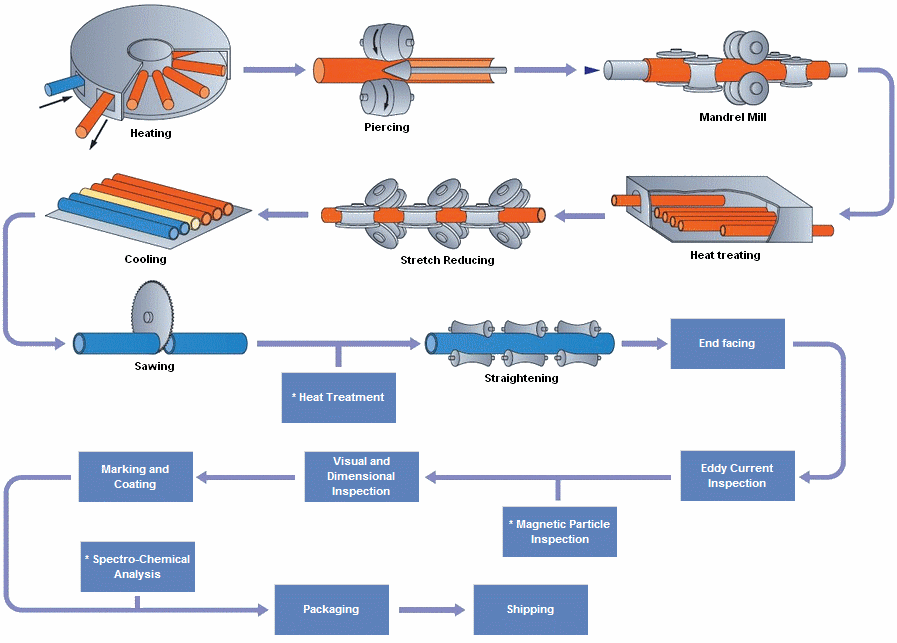
The “seamless” nature of these pipes is their primary defense mechanism. Unlike welded pipes, which harbor a heat-affected zone (HAZ) prone to preferential corrosion, seamless pipes are birthed through the Mannesmann piercing process or hot extrusion. The current frontier in manufacturing involves the optimization of the “Three-Roll Pipe Mill.”
In this process, the stress state of the metal during deformation is critical. By utilizing Finite Element Analysis (FEA), researchers have mapped the temperature gradient during the piercing of heavy-wall tubes. If the temperature drops below the recrystallization threshold even by a few degrees, internal micro-tears (often called “crow’s feet”) develop. These defects are invisible to the naked eye but act as nucleation sites for hydrogen-induced cracking (HIC) once the vessel is at sea.
The Role of Heat Treatment
Post-production heat treatment—specifically quenching and tempering (Q+T)—is where the final mechanical properties are “locked in.” For marine applications, the cooling rate must be precisely controlled to avoid the precipitation of brittle sigma phases in high-alloy steels. Research into “induction heating” for localized tempering has allowed for pipes that possess a hard, wear-resistant outer surface while maintaining a ductile core, perfect for the mechanical stresses of a ship’s hull flexing in heavy swells.
Corrosion Dynamics in Hyper-Saline Environments
The ocean is not a static fluid; it is a chemically active electrolyte. The research into “Pitting Resistance Equivalent Number” (PREN) has become the gold standard for specifying marine pipes. The formula:
This equation dictates the pipe’s ability to resist localized breakdown of the passive oxide layer. In stagnant seawater, such as in ballast tanks or fire main systems, biofilm formation can lead to Microbiologically Influenced Corrosion (MIC). Recent explorations have integrated copper-nickel (Cu-Ni) linings within seamless steel pipes to combine the structural strength of steel with the natural biofouling resistance of copper.
Future Trajectories: Intelligence and Sustainability
The “Exploration” phase of seamless pipe development is currently pivoting toward “Smart Piping.” This involves the embedding of fiber optic sensors within the insulation or even the pipe wall itself using additive manufacturing techniques. These sensors provide real-time data on wall thinning and vibration frequencies.
Furthermore, the drive toward “Green Shipping” and LNG-powered vessels has necessitated the development of cryogenic seamless pipes. These must withstand temperatures as low as -163°C without undergoing a ductile-to-brittle transition. Nickel-alloy steels (specifically 9% Ni steel) are the current focus of intense R&D to reduce costs while maintaining safety margins.
Conclusion and Technical Outlook
The evolution of marine seamless steel pipes is moving away from bulk production and toward “bespoke metallurgy.” As we move into 2026 and beyond, the integration of AI-driven molecular modeling will allow us to simulate how a specific alloy will behave over a 30-year lifespan in the North Sea before the first ingot is even cast. The goal remains unchanged: to create a conduit that is as enduring as the vessel it serves, bridging the gap between mechanical rigidity and environmental resilience.