Paip keluli diameter diameter besar
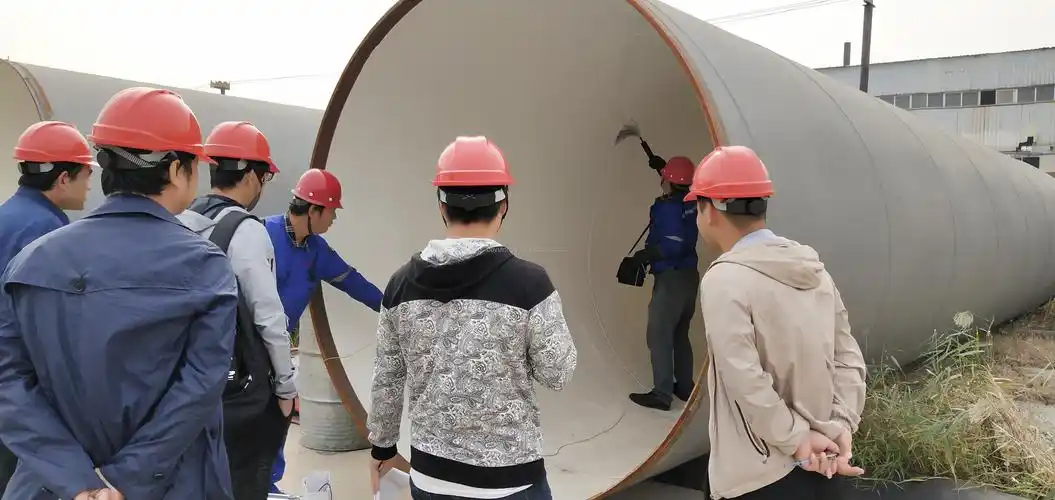
API 5L Gred B diameter besar melihat paip keluli berdiri sebagai produk asas dalam sektor tenaga dan infrastruktur global, manifestasi teknikal keperluan kritikal untuk mengangkut jumlah cecair yang besar dan selamat-sering-sering gas asli tekanan rendah, minyak mentah, atau buburan air -di mana kapasiti aliran tinggi, ditentukan oleh diameter besar, diprioritaskan atas keupayaan penahanan tekanan yang melampau ciri yang lebih tinggi $\text{API 5L}$ gred seperti $\text{X65}$ atau $\text{X80}$. Pemilihan Gred B ($\text{Gr. B}$) adalah pilihan ekonomi dan kejuruteraan yang disengajakan, Menentukan kekuatan hasil minimum yang ditentukan minimum ($\text{SMYS}$) dari $35,000$ psi, yang merupakan tahap kekuatan standard terendah dalam $\text{API 5L}$ keluarga, Posisi paip untuk aplikasi di mana tekanan reka bentuk adalah sederhana tetapi jumlah dan skala projek memerlukan saiz besar dan kecekapan pembuatan yang diberikan oleh saw (Kimpalan Arka Terendam) proses. Kekuatan yang seolah -olah rendah ini memungkiri ketegasan teknikal $\text{API 5L}$ standard, yang memastikan bahawa walaupun gred peringkat asas ini tertakluk kepada ujian yang jauh lebih ketat, Kawalan dimensi, dan protokol jaminan kualiti daripada paip struktur standard, menjamin tahap kebolehpercayaan yang penting bagi mana-mana saluran paip jarak jauh.
Ciri -ciri penting penting produk ini terletak pada proses pembuatan diameter besar diameter, yang sangat menggembirakan sama ada lsaw (Arka Tenggelam Membujur Dikimpal) kaedah, biasanya dicapai melalui uoe kompleks (U-ing, O-ing, dan berkembang) atau JCOE (J-inten, C-ing, O-ing, dan berkembang) proses membentuk, atau ssaw (Kimpalan Arka Terendam Lingkaran) kaedah, Kelebihan ekonomi kedua -dua kaedah menjadi keupayaan mereka untuk mewujudkan bahagian paip dengan berkesan dengan diameter kerap melebihi $\text{NPS 24}$ sehingga $\text{NPS 60}$ atau lebih besar, sering melibatkan ketebalan dinding yang besar ($\text{WT}$). The $\text{LSAW}$ proses, yang melibatkan plat keluli pembentukan sejuk (dipotong dari lebih luas $\text{TMCP}$ atau lembaran bergulung secara konvensional) menjadi bentuk silinder dan mengimpal single, jahitan lurus secara dalaman dan luaran menggunakan tenaga tinggi, Penyerahan tinggi ** Kimpalan arka tenggelam ($\text{SAW}$) ** teknik, menghasilkan struktur mikro seragam dan kestabilan dimensi yang sangat baik, tetapi memerlukan tekanan hidraulik yang besar dan pelaburan modal yang besar. Sebaliknya, The $\text{SSAW}$ proses menggunakan gegelung keluli sempit, SPIRALLY menggulungnya untuk membentuk paip dan mengimpal jahitan heliks, Menawarkan fleksibiliti dimensi yang lebih besar dan kos bahan input yang lebih rendah, Walaupun memperkenalkan kerumitan unik jahitan kimpalan yang berjalan pada sudut ke paksi tekanan utama, perbezaan yang mesti diuruskan dengan teliti melalui berterusan $\text{NDT}$ (Ujian Tidak Memusnahkan) Untuk kedua-dua kaedah untuk memastikan integriti mutlak zon kimpalan besar.
Asas metalurgi bahan gred 5l API, sementara lebih mudah daripada aloi mikro, tinggi-$\text{TMCP}$ Keluli yang digunakan untuk $\text{X}$ gred, masih ditadbir oleh had komposisi kimia yang ketat yang dimandatkan oleh $\text{API 5L}$, memberi tumpuan terutamanya untuk memastikan kebolehkalasan yang sangat baik di kilang $\text{SAW}$ proses dan, secara kritis, Semasa kimpalan medan berikutnya di mana segmen paip disatukan di bawah keadaan cuaca yang berubah -ubah. Karbon ($\text{C}$) kandungan biasanya terhad kepada maksimum $0.26\%$, dan sulfur ($\text{S}$) dan fosforus ($\text{P}$) Sisa dikawal dengan ketat ke tahap yang rendah ($\text{S} \le 0.015\%, \text{P} \le 0.030\%$) untuk meminimumkan risiko kecacatan dalaman seperti pemisahan dan kerentanan terhadap keretakan yang disebabkan oleh hidrogen ($\text{HIC}$), mod kegagalan yang berpotensi, terutamanya secara besar -besaran, input haba yang tinggi $\text{SAW}$ kimpalan. Setara karbon ** yang dikira ($\text{CEq}$) ** daripada $\text{Gr. B}$ Keluli adalah metrik teknikal utama, sengaja terus rendah untuk memastikan keluli tetap sangat serasi dengan pemendekkan tinggi, persekitaran hidrogen rendah $\text{SAW}$ proses, prasyarat untuk mencapai yang mantap, gabungan integriti tinggi yang diperlukan sepanjang panjang jubin kimpalan besar diameter.
Keperluan fungsi utama paip besar ini adalah keupayaannya untuk mengandungi tekanan, dikira oleh keperluan tegangan $\text{API 5L Gr. B}$, yang menentukan minimum $\text{SMYS}$ dari $35,000 \text{ psi}$ dan kekuatan tegangan minimum minimum ($\text{SMTS}$) dari $60,000 \text{ psi}$. Nilai -nilai ini tidak sewenang -wenang; Mereka adalah asas untuk mengira tekanan operasi yang selamat melalui formula barlow ($\text{P} = 2 \text{t} \times \text{SMYS} \times \text{E} \times \text{F} / \text{OD}$), di mana $\text{P}$ adalah tekanan, $\text{t}$ adalah ketebalan dinding, $\text{E}$ adalah faktor kecekapan bersama, $\text{F}$ adalah faktor reka bentuk, dan $\text{OD}$ adalah diameter luar. Walaupun untuk $\text{Gr. B}$, Pengiraan ini memberi mandat bahawa kekuatan bahan paip, ditambah dengan ketebalan dindingnya, mencukupi untuk mengandungi tekanan hidrostatik sehingga tekanan gelung yang dihasilkan tetap baik dalam batas elastik, memastikan paip tidak mengalami ubah bentuk plastik semasa operasi rutin atau semasa ujian hidrostatik kritikal. Wajib $\text{API 5L}$ Protokol ujian memastikan bahawa keperluan kekuatan disahkan bukan sahaja pada logam asas tetapi juga merentasi lebar jubin kimpalan gergaji, Selalunya melalui ujian tegangan melintang khusus yang memastikan logam kimpalan dan zon yang terjejas haba ($\text{HAZ}$) Jangan jatuh di bawah $\text{SMTS}$ bahan induk, Pengesahan utama kualiti pembuatan.
Cabaran pembuatan paip diameter besar memperkenalkan kekangan kompleks yang berkaitan dengan toleransi dimensi dan geometri, yang sama pentingnya dengan integriti saluran paip sebagai kekuatan material itu sendiri. Skala paip yang semata -mata membuat pengendalian ovaliti (perbezaan antara maksimum dan minimum $\text{OD}$) dan kelebihan sangat sukar, Namun parameter ini penting untuk fit-fit dan kimpalan bidang yang berjaya. Ovality yang berlebihan menjadikan menjajarkan paip bersebelahan untuk kimpalan lilitan mustahil tanpa daya utama, membawa kepada jurang kimpalan yang tidak seragam dan kecacatan pas akar yang berpotensi. Begitu juga, Squareness akhir paip dan konfigurasi tepat sudut serong adalah penting, kerana penyimpangan secara langsung mempengaruhi kualiti dan integriti kimpalan lapangan, yang mesti dilakukan dengan pasti di bawah tekanan berterusan saluran paip. The $\text{API 5L}$ Spesifikasi menetapkan had ketat pada toleransi ini, dan diameter besar $\text{SAW}$ Paip mesti diukur dan berkelayakan menggunakan alat pengukur khusus dan peralatan pengimbasan untuk memastikan setiap meter memenuhi standard, Mencegah kelewatan pembinaan hiliran dan kerja semula yang mahal di lapangan, mandat teknikal praktikal yang menyokong keseluruhan kejayaan logistik projek saluran paip.
Tambahan pula, integriti $\text{SAW}$ Jahitan kimpalan, tidak kira sama ada $\text{LSAW}$ atau $\text{SSAW}$, disahkan oleh ketat **$100\%$ Ujian Tidak Memusnahkan ($\text{NDT}$) ** Protokol, lapisan keselamatan asas dari $\text{API 5L}$ standard. Ini biasanya melibatkan menggunakan ** ujian ultrasonik automatik ($\text{AUT}$) ** Untuk mengimbas keseluruhan jilid kimpalan, berusaha untuk mengesan kecacatan dalaman seperti kekurangan gabungan, Kemasukan Slag, atau keliangan dalaman yang boleh menjejaskan kekuatan pecah paip atau menyebabkan kegagalan keletihan. Untuk $\text{LSAW}$ paip, lurus, garis kimpalan yang boleh diramalkan memudahkan $\text{AUT}$, manakala $\text{SSAW}$ memerlukan lebih kompleks, Pengaturan transduser bersudut untuk mengira laluan lingkaran. Selain itu, $\text{Radiographic Testing ($\text{X-ray}$ or $\text{Gamma Ray}$) ** is often mandated, particularly at the pipe ends, to verify the weld quality in areas prone to start/stop defects, providing volumetric confirmation of soundness. The combination of these $\text{NDT}$ techniques ensures that the large, high-heat $\text{SAW}$ weld is essentially flaw-free before the pipe leaves the mill, a non-negotiable requirement for a product intended to contain high-pressure, often hazardous, fluids over decades of service.
The final structural proof and assurance of the API 5L Gr. B Large Diameter SAW Pipe is the mandatory, non-destructive Hydrostatic Test. Every single length of pipe is filled with water and pressurized to a level significantly exceeding its $\text{MAOP}$. This test is a crucial mechanical filter, proving the pipe’s elastic strength and revealing any existing flaws in the $\text{SAW}$ weld or the body that are close to the critical size, guaranteeing that the pipe can withstand the design pressure with a high margin of safety. While $\text{Gr. B}$ steel has a lower $\text{SMYS}$ compared to $\text{X}$ grades, its wall thickness is often large enough to achieve the required pressure capacity, and the Hydrostatic Test confirms that this design choice is structurally sound, making the test the ultimate seal of quality for the final large diameter product.
The investment in API 5L Grade B Large Diameter SAW Steel Pipe is not merely a procurement decision; it is a strategic commitment to decades of predictable, high-volume fluid conveyance, underwritten by the most stringent certification system in the global pipeline industry. Our product leverages the immense dimensional capacity inherent in the Submerged Arc Welded (SAW) manufacturing process—the proven backbone for large diameter transmission lines—and combines it with the strategically cost-effective Grade B material, creating a solution that is perfectly optimized for projects where flow capacity is king and operational pressure is moderate. This is the intelligent engineering choice, eschewing the unnecessary expense and fabrication complexity of higher-strength $\text{X}$ grades where the design pressure does not warrant them, thereby delivering the maximum return on investment without compromising the non-negotiable standards of safety and structural integrity demanded by the $\text{API 5L}$ specification. The large diameter capability, whether achieved through the linear precision of LSAW or the material efficiency of SSAW, guarantees that your project achieves the desired throughput, minimizing the frictional head loss and the long-term pumping energy consumption, making the initial investment a powerful predictor of operational efficiency and financial sustainability across the entire lifecycle of the pipeline.
The foundational strength of our offering lies in the **Grade B ($\text{SMYS} = 35,000 \text{ psi}$) ** material, a metallurgical masterpiece of cost-efficiency meticulously controlled to meet the demanding parameters of $\text{API 5L}$ despite its position as the entry-level grade. Our commitment to maintaining an ultra-low **Carbon Equivalent ($\text{CEq}$) ** ensures that every length of our large diameter pipe possesses exceptional weldability, a critical factor that dramatically reduces the complexity, time, and defect rate during the high-stakes field girth welding process, minimizing installation risk and accelerating project schedules. This guaranteed, repeatable weld quality is further reinforced by the inherent reliability of the $\text{SAW}$ process itself, which utilizes a massive, protected arc to deposit high-quality, high-volume weld metal, forming a seam that is consistently stronger and more ductile than the parent material, a technical assurance that is subsequently validated by the unyielding rigor of **$100\%$ Non-Destructive Testing ($\text{NDT}$) **. Every millimeter of the extensive $\text{SAW}$ seam is scanned by Automatic Ultrasonic Testing ($\text{AUT}$), eliminating volumetric defects and guaranteeing a flaw-free pressure boundary that meets or exceeds the uncompromising standards of the American Petroleum Institute, giving our clients absolute, verifiable confidence in the integrity of the pipe they bury.
Furthermore, the operational security of our large diameter $\text{Gr. B}$ pipe is ultimately confirmed by the non-negotiable Hydrostatic Test, a process that transcends simple quality control to become the pipeline’s final, structural Proof of Concept. Each pipe section is individually subjected to internal pressures significantly exceeding the final operating pressure, effectively placing every element—the $\text{Gr. B}$ body steel, the $\text{SAW}$ seam, and the end geometry—under maximum design stress. This rigorous testing filters out any potential flaws or weaknesses, ensuring that the material has achieved its full **Specified Minimum Yield Strength ($\text{SMYS}$) ** guarantee, and providing the ultimate assurance that the pipe will perform reliably under the sustained loads of service for its entire design life. . This commitment to pressure-testing every single length translates directly into risk mitigation for our clients, providing an auditable, quantifiable safety standard that is the hallmark of $\text{API 5L}$ excellence. The impeccable dimensional control of our large diameter product, covering ultra-tight tolerances on ovality, end squareness, and $\text{OD}$, ensures that this structural integrity translates seamlessly into smooth, rapid, and defect-free field installation, providing the necessary precision that high-volume construction projects demand, positioning our API 5L Grade B Large Diameter SAW Steel Pipe as the technically superior and economically advantageous choice for tomorrow’s essential infrastructure.
Structured Technical Specification Data: API 5L Grade B Large Diameter SAW Steel Pipe
| Category | Technical Specification | Typical Requirements & Standards | Technical Significance |
| Material Grade | API 5L Grade B (Gr. B) | $\text{API Specification 5L}$. Common for lower pressure service. | $\text{SMYS}$ (Specified Minimum Yield Strength) Min. $35,000 \text{ psi}$ (240 $\text{MPa}$). Provides base-level pressure containment capacity. |
| Manufacturing Method | SAW (Submerged Arc Welded) | $\text{LSAW}$ (Longitudinal) or $\text{SSAW}$ (Spiral) processes used. | Essential for economically producing Large Diameter Pipe ($\text{NPS 24+}$) with high $\text{WT}$ and high-quality weld seams. |
| Dimensions | Large Diameter, Various WT | $\text{OD}$ typically $\ge \text{NPS 24}$. **Wall Thickness ($\text{WT}$) ** varies based on design pressure requirements. | Large size maximizes flow capacity for high-volume transmission lines. $\text{WT}$ is chosen to meet $\text{MAOP}$ based on $\text{Gr. B}$ strength. |
| Governing Standard | API Specification 5L | Defines material grades, $\text{NDT}$, testing (Hydrostatic, Flattening, Tensile), and dimensional tolerances. | The international standard for line pipe, ensuring safety and integrity in fluid transmission. |
| Chemical Composition | Controlled $\text{CEq}$ | $\text{C}$ Max $0.26\%$. $\text{Mn}$ Max $1.20\%$. $\text{P}$ Max $0.030\%$. $\text{S}$ Max $0.030\%$. | Low $\text{CEq}$ ensures good weldability during the high-heat $\text{SAW}$ process and facilitates easy field welding. |
| Heat Treatment Req. | As-Welded or Normalized | Typically supplied in the $\text{As-Welded}$ condition. Normalizing or stress relief may be required for specific service conditions. | Minimizes residual stresses and ensures the $\text{SAW}$ weld $\text{HAZ}$ microstructure is sound and free from hard zones. |
| Tensile Requirements | SMYS & SMTS | $\text{SMYS}$ Min $35,000 \text{ psi}$. $\text{SMTS}$ Min $60,000 \text{ psi}$. Elongation Min. $23\%$. | Guarantees the necessary strength and ductility for pressure containment and resistance to mechanical failure. |
| Application | Line Pipe (Moderate Pressure) | Transport of water, natural gas, crude oil, and slurry where large flow capacity is required. | Optimized for long-distance, high-volume transmission under moderate pressure and external loads. |
| Features | High Flow Capacity, Weld Integrity | $\text{Features:}$ Excellent $\text{SAW}$ weld quality, high dimensional control, proven $\text{NDT}$ certification. | The large diameter provides immense capacity; $\text{SAW}$ welding ensures the $\text{API 5L}$ integrity for the entire pipe length. |
| Tolerance of $\text{OD}$ and $\text{WT}$ | API 5L Dimensional Tolerances | Ovality and Straightness are tightly controlled. $\text{WT}$ tolerance is typically $\pm 10\%$. $\text{OD}$ tolerance is tight ($\pm 0.5\%$). | Tight control of $\text{OD}$ and ovality is critical for efficient and defect-free field welding fit-up of large pipe sections. |
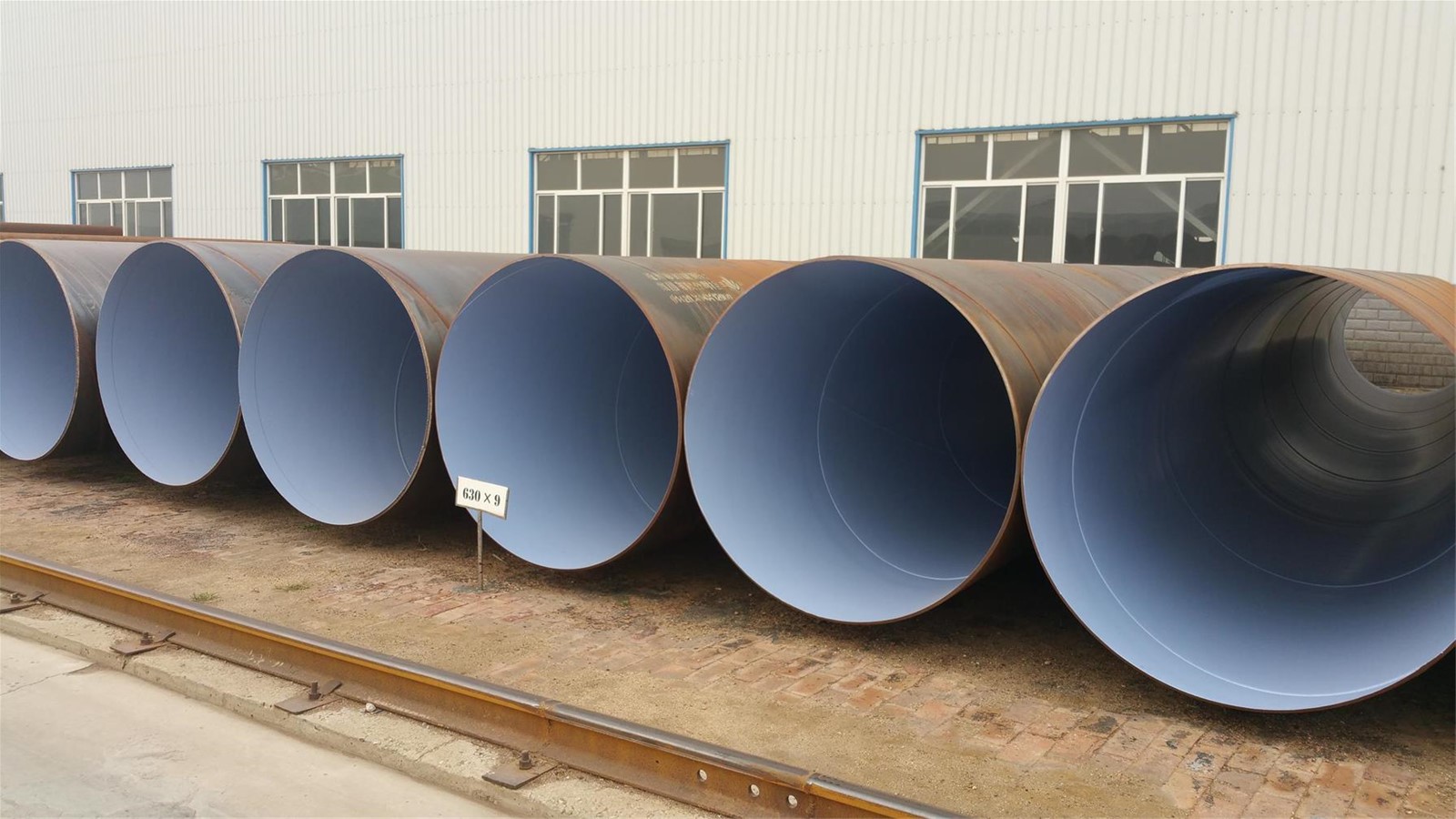
paip keluli SSAW, juga dikenali sebagai paip keluli yang dikimpal arka tenggelam lingkaran, ialah paip keluli dikimpal lingkaran yang dihasilkan oleh kimpalan arka tenggelam dua muka. Paip dikimpal lingkaran dibentuk menggunakan kepingan yang lebih sempit atau gegelung gelek panas, yang sangat mengurangkan kos pengeluaran mereka. Proses kimpalan lingkaran membolehkan pengeluaran paip diameter besar yang sesuai untuk mengangkut minyak dan gas dalam kuantiti yang banyak.
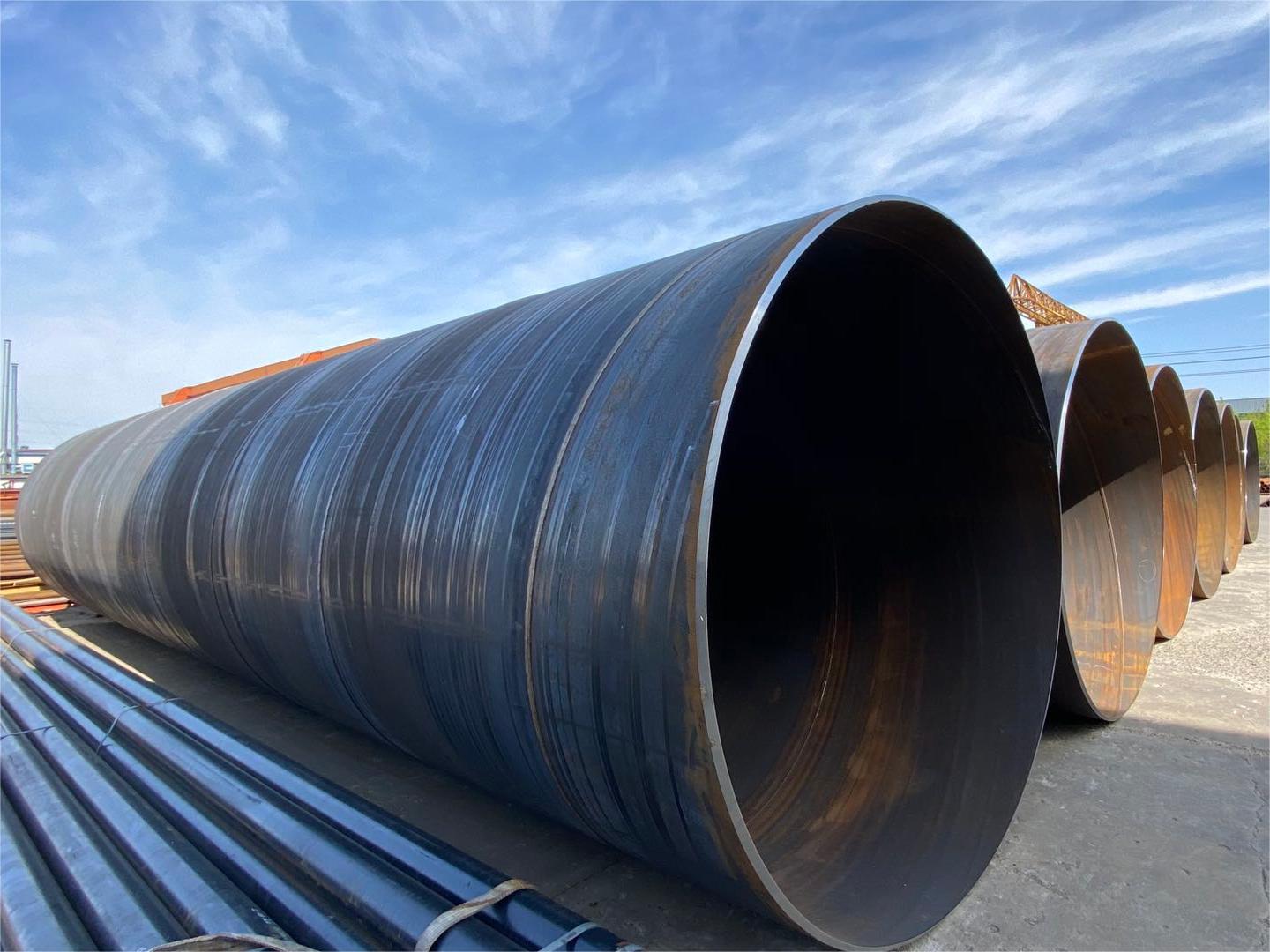
Paip keluli SSAW menawarkan penyelesaian praktikal untuk pelbagai aplikasi yang memerlukan tahan lama, berdiameter besar, dan paip panjang. Walaupun mereka mempunyai had tertentu dari segi ketepatan dan potensi kecacatan, keberkesanan kos dan kekuatan mereka menjadikan mereka pilihan popular dalam pelbagai industri. Untuk aplikasi tertentu, adalah penting untuk memilih gred yang sesuai dan mematuhi piawaian yang berkaitan untuk memastikan keselamatan dan kecekapan.
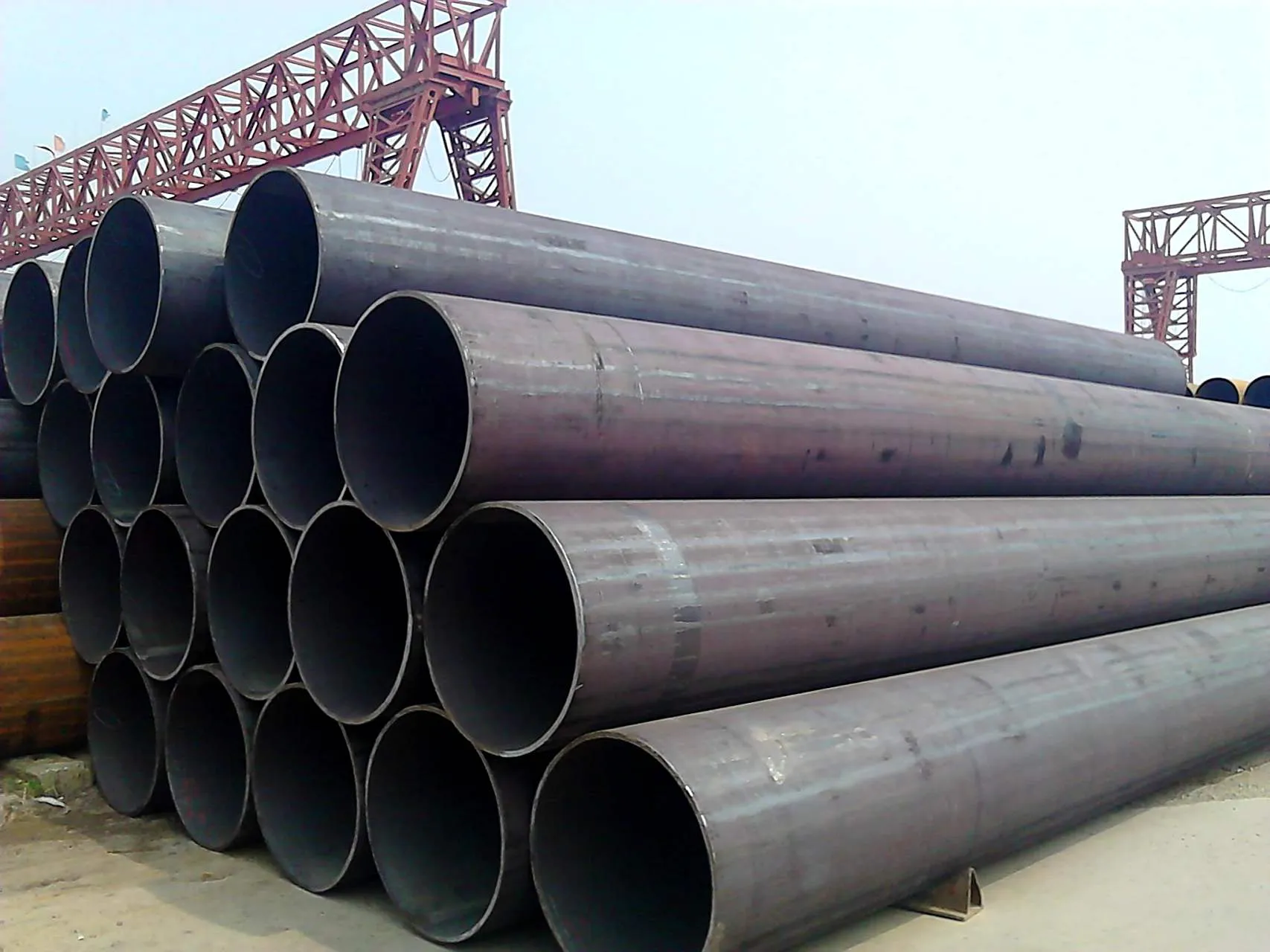
Julat gred keluli di bawah ** en 10219-1** standard-dari ** S235Jrh ** yang boleh dipercayai melalui serba boleh ** S355JOH/JEH ** kepada prestasi tinggi ** S460MH **-menyediakan penyelesaian bahan penting untuk setiap cabaran asas yang mendalam. Standard Eropah ini menjamin bukan sahaja ** sifat mekanikal ** ** (Menghasilkan kekuatan sehingga 460 MPa) tetapi juga kritikal ** kesan ketangguhan ** ($\teks{J0}/\teks{J2}$) dan unggul ** kebolehkalasan ** melalui kawalan ketat ** bersamaan karbon **.
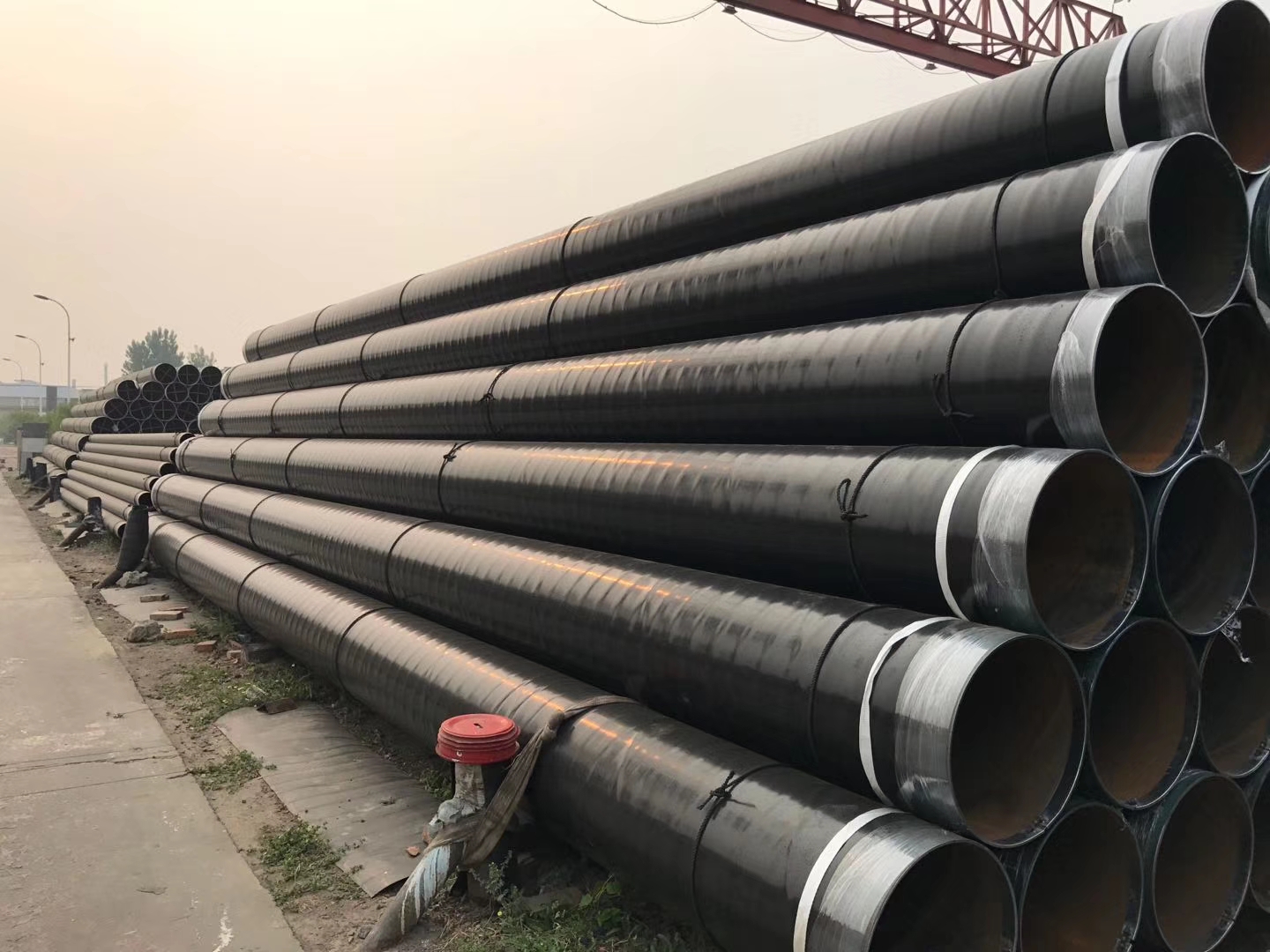
API 5L Carbon Steel SSAW Pipa adalah sekeping infrastruktur kejuruteraan yang sangat khusus, Penyelesaian material secara asasnya ditakrifkan bukan oleh kekangan dimensi mudah atau perlindungan kakisan gred utiliti, Tetapi dengan mengejar kekuatan tinggi tanpa henti, Integriti kimpalan yang boleh dipercayai, dan ketangguhan patah yang luar biasa, semua perlu untuk memastikan keselamatan, tidak terganggu, dan pengangkut tekanan tinggi hidrokarbon, gas asli, atau buburan cecair padat merentasi landskap geologi dan alam sekitar yang luas. Tidak seperti yang biasa